From Frozen Solid to Open for Business
It's hard to believe that just last month I was down at Crystal Beach, a small town on the shores of Lake Erie, and the lake was approximately 95% frozen (you can see what it looked like here). On February 8th a crack roughly 80 miles long formed across the ice, stretching from Port Burwell, Ontario to near Cleveland, Ohio. It was so large it was visible from space via satellite imagery.
The ice clearly didn't waste much time melting. The Welland Canal opened for its 197th navigation season on March 22, 2026, with a Top Hat celebration.
Cruise ships begin calling at ports along the canal route from mid-April.
A Canal Worth Knowing
The Welland Canal is the 43.5-kilometre waterway that connects Lake Ontario and Lake Erie across the Niagara Peninsula of southwestern Ontario. Without it, there would be no practical way for large vessels to move between the two lakes — Niagara Falls and the turbulent Niagara River make that abundantly clear. The canal bridges a height difference of 99.4 metres between the lakes through eight locks, each 24.4 metres wide.
It was conceived and championed by William Hamilton Merritt, a St. Catharines businessman who saw the need for a navigable route around the Falls. The first canal was excavated between 1824 and 1829, opening to navigation on November 30, 1829. The canal you transit today — the Fourth Welland Canal — began construction in 1913 and was completed in 1932. A significant rerouting known as the Welland Bypass was added between 1967 and 1972, diverting the canal around the city of Welland to reduce the traffic disruptions caused by constant bridge openings through the downtown core.
🚯 Canal at a Glance
- Length: 43.5 kilometres across the Niagara Peninsula
- Locks: Eight locks, each 24.4 metres wide
- Height difference: 99.4 metres between Lake Ontario and Lake Erie
- Minimum water depth: 9.1 metres
- Lock length (Locks 1–7): 233.5 metres
- Runs from: Port Weller on Lake Ontario (north) to Port Colborne on Lake Erie (south)
- Communities along the canal: St. Catharines, Thorold, Welland, Port Colborne
- 2026 season closes: January 10, 2027
Part of Something Bigger
The Welland Canal is the critical link in the Great Lakes St. Lawrence Seaway System — the binational network of locks, canals, and channels connecting the Atlantic Ocean to the interior of the continent. The Seaway has operated since 1959; 2026 marks its 68th navigation season. The Welland Canal has been doing this work for well over a century longer.
The numbers behind this waterway are worth pausing over. In 2025, nearly 37 million tonnes of cargo moved through the Seaway system. The network supports more than $50 billion USD in economic activity across Canada and the United States combined, and sustains upwards of 350,000 jobs in both countries. The grain, iron ore, and manufactured goods moving through these eight locks reach markets far beyond North America — this is a waterway that helps feed and supply people around the world.
The Top Hat Ceremony
Each spring when the canal reopens, the captain of the first vessel to transit is presented with a ceremonial top hat. It speaks to the real affection these communities have for their waterway and for the mariners who keep this tradition alive.
In 2026, the season's opening was marked by two separate ceremonies — one at Lock 8 Gateway Park in Port Colborne, and one at the St. Catharines Museum and Welland Canals Centre at Lock 3, honouring the first vessel in each direction.
Port Colborne Mayor Bill Steele presented the top hat to Captain Donald Kemp, master of the first downbound vessel of the 2026 season — heading from Lake Erie toward Lake Ontario.
The upbound honour went to Captain Easton of McKeil Marine's self-unloading bulk carrier. At 36, this was his first Top Hat Ceremony — and the hat placed on his head was only the third ever used, and the first crafted from genuine beaver pelt. After the ceremony, Northern Venture departed for Port Colborne to load grain bound for Toledo, Ohio.
💡 Jules' Note: The Top Hat Ceremony has only used three hats in its entire history. The 2026 upbound hat — beaver pelt, first of its kind — is genuinely a piece of Canadian maritime history.
Going Up vs. Going Down: What Cruisers Should Know
This surprises a lot of first-time Great Lakes cruisers: the direction of your canal transit matters, and the two experiences are quite different.
When your ship travels upbound — from Lake Ontario toward Lake Erie — it rises the full 99.4 metres in elevation. You enter each lock at its lowest point, the gates close, and the chamber floods to lift you to the next level. The lock walls rise on both sides as the ship climbs. It is a remarkable thing to watch from the deck.
When travelling downbound, the process reverses: you enter each lock at the top of the chamber, the water drains away, and the ship descends toward Lake Ontario. Same engineering, entirely different feeling. If you know which direction your itinerary includes, it's worth planning your deck time accordingly — you won't want to miss either one from inside a cabin.
The Four Canal Communities
Each of the four towns bordering the canal offers something worth exploring when you're ashore:
The southern terminus at Lake Erie. The city has invested in its waterfront for cruise visitors, and Lock 8 Gateway Park gives you excellent elevated views of ships transiting the final lock into open water.
A bypass was constructed for commercial shipping, leaving the section of canal through the city for recreational use. Three rowing clubs call it home, and the waterway hosts a busy calendar of regattas including rowing, dragon boat racing, and recreational paddling.
This is where things get dramatic. Locks 4, 5, and 6 are stacked in close succession up the face of the Niagara Escarpment — a compelling display of what it actually took to engineer this route. The Lock 7 viewing area is also here, one of the most popular ship-watching spots along the entire route.
The region's largest city, at the northern end near Port Weller. The St. Catharines Museum and Welland Canals Centre at Lock 3 is one of the finest places in Canada to watch a Great Lakes freighter pass at close range.
Cruise Ships on the Welland Canal in 2026
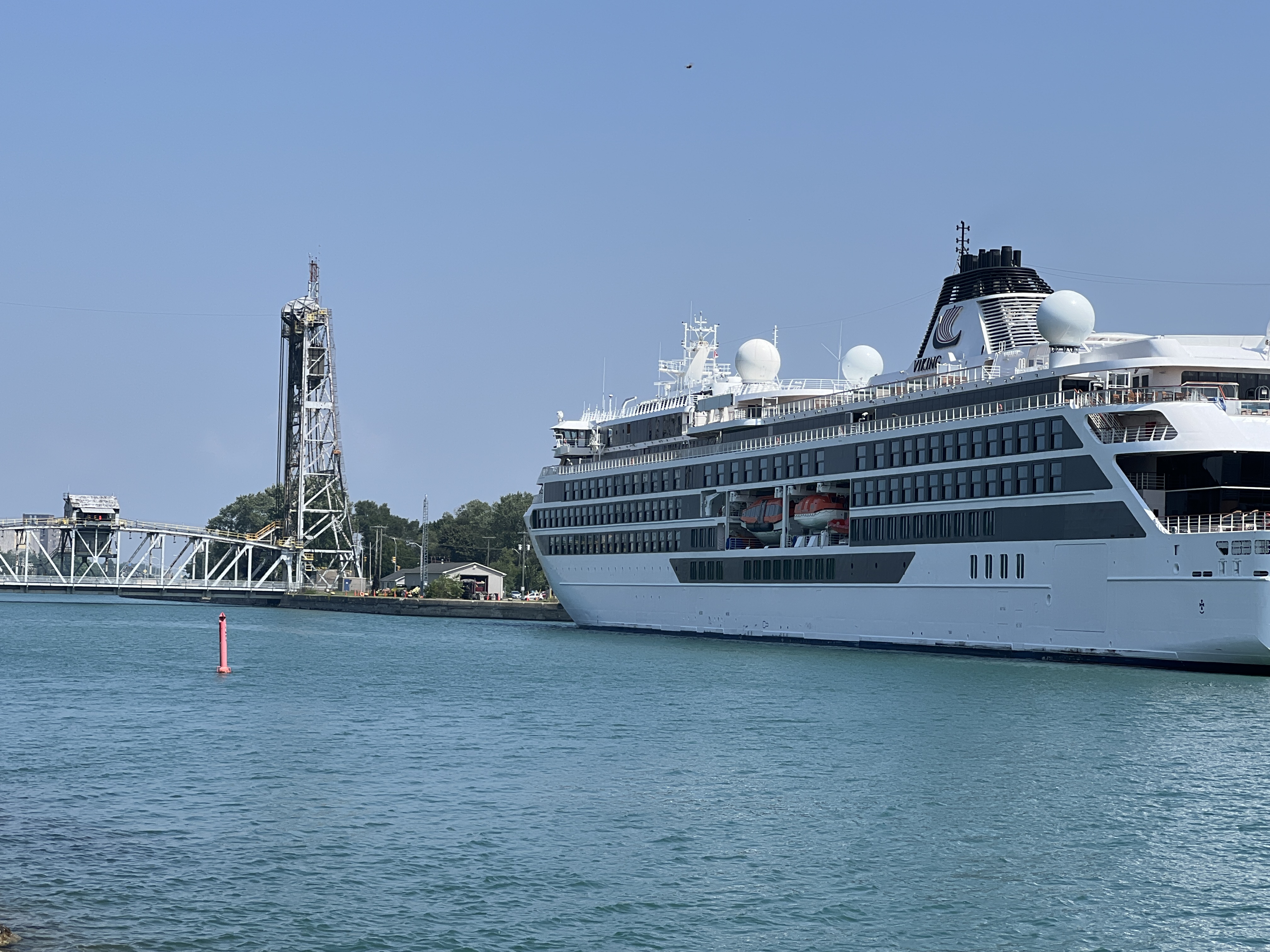
Great Lakes cruising is growing fast, and Port Colborne's 2026 schedule reflects that. Four cruise lines are scheduled to make a combined 66 calls to Port Colborne between mid-April and the end of October:
- Viking Cruises
- Victory Cruise Lines
- Pearl Seas Cruises
- Ponant
The City of Port Colborne maintains the official 2026 cruise ship schedule on its website — it's the most reliable resource for specific arrival dates and vessel names if you're planning a shoreside visit to watch a ship come through. You can find that schedule at portcolborne.ca/cruiseships.
🚢 Planning a Shoreside Visit?
If you're not on one of these ships but want to watch the transit, the Lock 3 viewing area in St. Catharines and the Lock 8 Gateway Park in Port Colborne are both free and accessible. Check the Port Colborne schedule for dates — nothing quite prepares you for how large these ships look passing through a lock at close range.
Sources
- Welland Canal opens for 2026 season with top hat tradition — CHCH News
- St. Lawrence Seaway opens 2026 shipping season with Top Hat ceremony — CHCH News
- Top Hat Ceremony — City of Port Colborne
- Cruise Ships — City of Port Colborne
- Great Lakes St. Lawrence Seaway System
- Welland Canal — The Canadian Encyclopedia
- Satellite Image Reveals Giant Crack in Lake Erie — Newsweek
Schedules and vessel assignments are subject to change. Always confirm current details directly with your cruise line or the City of Port Colborne's official cruise schedule.